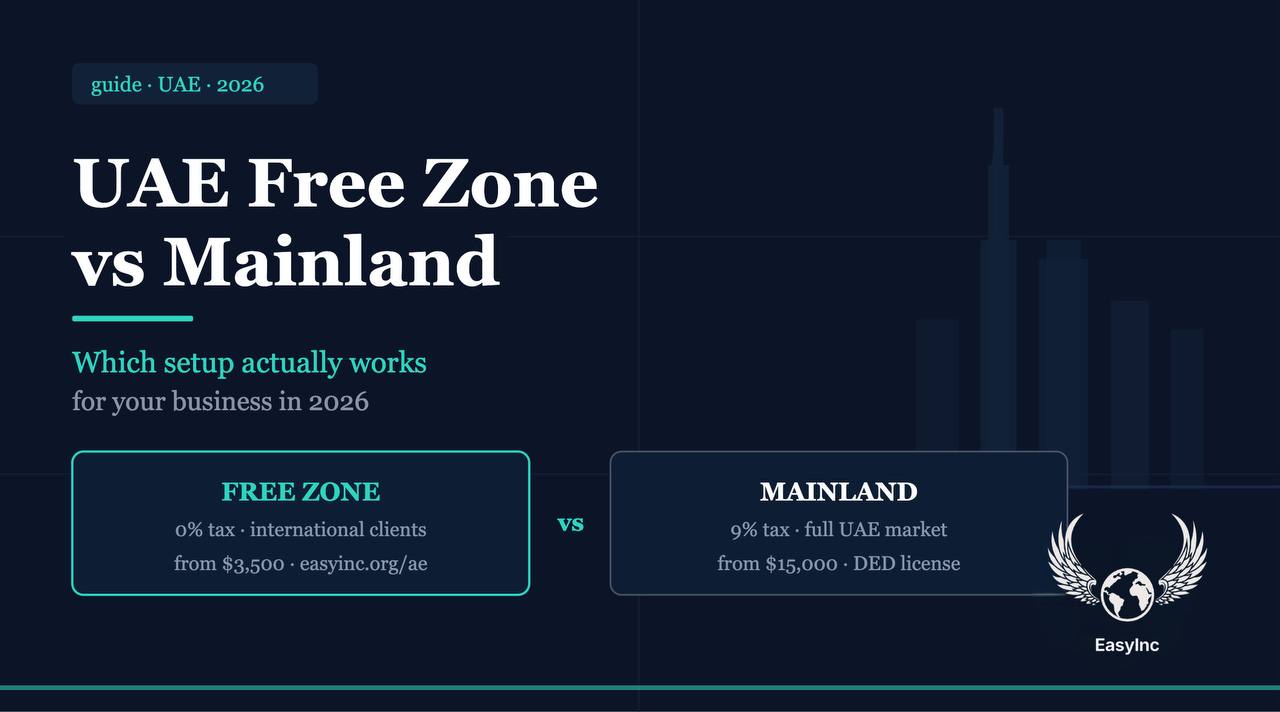
UAE Free Zone vs Mainland: Which Setup Actually Works for Your Business in 2026
The UAE is one of the most popular destinations for international business formation. Zero personal income tax, a stable currency, world-class infrastructure, and a government that has spent the last decade actively competing for global entrepreneurs.
But when you start researching, you hit the same question immediately: Free Zone or Mainland?
Most guides give you a vague answer. "It depends on your business." That's technically true and practically useless. This guide gives you the actual framework: what each structure is, what it costs, what it allows, where it breaks, and which type of business belongs in which structure.
1. The Fundamental Difference Between Free Zone and Mainland
The UAE is not one jurisdiction. It's a federation of seven emirates, each with its own government, laws, and economic zones. Within those emirates exist over 45 designated Free Zones: special economic areas with their own regulatory authorities, licensing frameworks, and tax rules.
Free Zone companies are registered within one of these designated zones. They operate under the rules of that specific Free Zone authority, not the UAE mainland government. The Free Zone authority issues licenses, processes visas, and regulates companies within its boundaries.
Mainland companies are registered with the Department of Economic Development (DED) of the relevant emirate. They operate under UAE federal law and the emirate's commercial regulations.
The core practical difference comes down to one question: where can you do business?
A Free Zone company can legally conduct business with clients outside the UAE, and with other Free Zone companies. It cannot, as a general rule, directly sell goods or services to customers on the UAE mainland without a mainland license or a local distributor agreement.
A Mainland company can do business anywhere: inside the UAE, outside the UAE, with government entities, with retail customers on the street.
This single distinction drives most of the decision-making.
2. Free Zone: How It Works, What It Costs, Who It's For
What a Free Zone company actually is
When you register a Free Zone company, you're creating a legal entity that exists within a designated economic zone. The Free Zone authority acts as your regulator, your licensing body, and in many cases your landlord if you take physical office space.
Each Free Zone has its own focus. DMCC targets trading and commodities. DIFC serves financial services. Dubai Internet City targets tech. Ajman Free Zone offers the lowest-cost setup. Choosing the right Free Zone affects what activities you're licensed for, what visa allocations you get, and what banking relationships are available.
What a Free Zone company allows
- 100% foreign ownership, no local sponsor required
- 0% corporate tax on qualifying income, subject to conditions covered in Section 5
- 0% personal income tax
- 100% repatriation of profits
- No import/export duties within the Free Zone
- Simplified incorporation, typically 1-2 weeks
- Visa eligibility for yourself and employees
What a Free Zone company does NOT allow
- Direct commercial activity on the UAE mainland (selling to mainland customers, operating mainland offices)
- Bidding on UAE government contracts
- Operating retail outlets, restaurants, or physical stores outside the Free Zone
- Certain licensed activities that require mainland approval
Cost breakdown
| Cost Item | Budget FZ (Ajman, IFZA, SHAMS) | Mid-Tier (DMCC, JAFZA) | Premium (DIFC, ADGM) |
| License fee (annual) | $1,500-$3,000 | $3,500-$6,000 | $8,000-$15,000+ |
| Establishment card | $300-$500 | $500-$800 | $800-$1,500 |
| Virtual office (flexi-desk) | $500-$1,500 | $1,500-$3,000 | $3,000-$6,000 |
| Physical office (if required) | $5,000-$15,000/yr | $10,000-$30,000/yr | $20,000-$100,000+/yr |
| Visa per person | $1,500-$2,500 | $2,000-$3,500 | $3,000-$5,000 |
| First-year total (solo, flexi-desk) | $4,000-$8,000 | $8,000-$15,000 | $15,000-$30,000+ |
Who Free Zone is right for
- Digital businesses, SaaS, consulting, marketing agencies
- International traders with no UAE retail presence
- Crypto and blockchain businesses (especially DMCC, DIFC)
- Financial services firms (DIFC, ADGM)
- Media and tech companies (Dubai Internet City, Dubai Media City)
- Solo operators and small teams who don't need mainland UAE clients
- Holding companies and IP ownership structures
3. Mainland: How It Works, What It Costs, Who It's For
What a Mainland company actually is
A Mainland company is a standard commercial entity registered with the DED of Dubai, Abu Dhabi, or another emirate. It operates under UAE federal commercial law and can conduct business anywhere in the UAE and internationally.
The biggest change in recent years: since 2021, the UAE has allowed 100% foreign ownership for most Mainland business activities. The old requirement for a 51% UAE national shareholder has been eliminated for the vast majority of business types.
What a Mainland company allows
- Full access to the UAE domestic market: retail, hospitality, construction, services
- Ability to bid on UAE government and semi-government contracts
- Opening offices anywhere in any emirate without restriction
- Operating physical retail, restaurants, clinics, or consumer-facing businesses
- Engaging with UAE mainland businesses directly, no distributor agreement required
- More banking options, as Mainland entities are viewed more favourably by traditional banks
Cost breakdown
| Cost Item | Dubai Mainland | Abu Dhabi Mainland |
| Trade license (annual) | $2,500-$5,000 | $2,000-$4,500 |
| Initial approvals and fees | $1,000-$3,000 | $1,000-$2,500 |
| Office lease (mandatory for most licenses) | $8,000-$25,000/yr | $6,000-$20,000/yr |
| Visa per person | $2,000-$3,500 | $2,000-$3,000 |
| Local service agent (where required) | $500-$2,000/yr | $500-$1,500/yr |
| First-year total (small team, basic office) | $15,000-$35,000 | $12,000-$28,000 |
Who Mainland is right for
- Businesses selling directly to UAE consumers or companies
- Restaurants, retail shops, clinics, salons, gyms
- Construction, real estate, and property-related businesses
- Companies that need government contracts
- Professional services firms with local UAE clients
- Any business where UAE is the primary market, not just the registration jurisdiction
4. Head-to-Head Comparison: 12 Dimensions That Actually Matter
| Dimension | Free Zone | Mainland |
| UAE market access | Only via distributor/agent | Direct, unrestricted |
| Foreign ownership | 100% (always) | 100% (most activities) |
| Corporate tax | 0% on qualifying income | 9% standard rate |
| Personal income tax | 0% | 0% |
| Minimum office requirement | Flexi-desk available | Physical office typically required |
| Setup cost | $4,000-$30,000+ | $15,000-$35,000+ |
| Annual maintenance | $3,000-$12,000 | $10,000-$30,000 |
| Banking access | Moderate | Better, more bank options |
| Visa allocation | Based on office size | Based on office size and license type |
| Government contracts | Not eligible | Eligible |
| Process complexity | Simpler | More complex in some sectors |
| Best for | International/digital business | UAE domestic market focus |
5. The Tax Reality in 2026 (After Corporate Tax)
The UAE introduced a 9% corporate tax in June 2023. Understanding how it applies and how it doesn't is essential before choosing your structure.
The 9% corporate tax: what it covers
The tax applies to taxable income exceeding AED 375,000 (approximately $102,000) per year, to all business entities registered in the UAE including Free Zone companies, and to UAE-sourced income regardless of where the company is registered.
Free Zone and the Qualifying Free Zone Person (QFZP) regime
Free Zone companies can still access 0% corporate tax, but only if they qualify as a Qualifying Free Zone Person. To qualify, a company must maintain adequate substance in the Free Zone with real presence. It must earn Qualifying Income, primarily from transactions with other Free Zone entities and international business. It must not have elected the standard 9% rate. And it must comply with transfer pricing rules.
What counts as qualifying income: income from transactions with other Free Zone Persons; income from qualifying activities such as manufacturing, holding shares, and certain financial services; income from transactions with foreign persons.
What does NOT count (taxed at 9%): revenue from direct sales to UAE mainland customers; passive income from domestic sources above certain thresholds.
A Free Zone company that primarily does international business can legitimately maintain 0% corporate tax. A Free Zone company that starts selling to UAE mainland customers will have that portion of income taxed at 9%.
Mainland companies and the 9% rate
Mainland companies are subject to the standard 9% corporate tax on taxable income above AED 375,000. For businesses primarily serving the UAE market, the 9% rate applies and the Mainland's access advantages often outweigh the tax difference.
6. Banking: Where Free Zone and Mainland Actually Differ
Banking is where the practical day-to-day difference between Free Zone and Mainland shows up most clearly.
Mainland companies generally have better traditional banking access. UAE banks including Emirates NBD, Mashreq, FAB, and RAKBank are more comfortable with Mainland entities. The DED license and physical office requirement signal real UAE presence. Approval rates are higher.
Free Zone companies vary significantly based on the Free Zone. DIFC and ADGM have exceptional banking access. DMCC companies have good access. Budget Free Zones like Ajman, SHAMS, and IFZA can be more challenging.
| Scenario | Banking Difficulty | Recommended Approach |
| DIFC / ADGM company | Easy | Full range of UAE and international banks |
| DMCC / JAFZA / major Free Zone | Moderate | Emirates NBD, Mashreq, DBS UAE |
| Budget Free Zone (Ajman, SHAMS) | Moderate-Hard | Start with EMI (Wise, Airwallex), then Mashreq or RAKBank |
| Dubai Mainland | Moderate | Emirates NBD, FAB, Mashreq |
| Abu Dhabi Mainland | Moderate | FAB, ADCB |
7. Visa and Residency: What Each Structure Gives You
Both structures allow you to sponsor UAE residency visas. The number of visas depends on your office size and license type, not whether you're Free Zone or Mainland.
| Office Type | Typical Visa Allocation |
| Flexi-desk / virtual office | 1-3 visas |
| Small physical office (up to 200 sqft) | 3-6 visas |
| Larger office | Scales with size |
| Mainland license (activity-based) | Varies by license type |
The UAE Golden Visa (10-year renewable residency) is available through both structures. If long-term UAE residency is a priority, structure the company with Golden Visa eligibility in mind from day one.
8. The Most Popular Free Zones and Which to Choose
| Free Zone | Best For | Setup Cost | Key Features |
| DMCC | Trading, commodities, crypto, general business | $8,000-$15,000 | Most licenses in UAE; crypto-friendly; good banking |
| DIFC | Financial services, fintech, funds, legal | $15,000-$50,000+ | DIFC Courts; best banking; institutional credibility |
| ADGM | Financial services, crypto, tech | $15,000-$40,000+ | Common law framework; excellent for fintech |
| Dubai Internet City | Tech, IT, software | $8,000-$15,000 | Co-location with major tech firms |
| Dubai Media City | Media, marketing, PR, content | $8,000-$15,000 | Media industry ecosystem |
| JAFZA | Logistics, manufacturing, import/export | $8,000-$20,000 | Port access; logistics hub |
| IFZA | General business, affordable | $3,500-$6,000 | Budget option; flexible activities |
| SHAMS (Sharjah) | Media, creative, general | $3,000-$5,500 | Very affordable; good for startups |
| Ajman Free Zone | Budget setup, general | $2,500-$4,500 | Cheapest option; limited banking access |
| RAK ICC | Offshore holding companies | $1,500-$3,000 | Holding and IP structure only |
9. Common Mistakes When Choosing Between the Two
Choosing a budget Free Zone, then discovering you can't serve UAE clients. The most common mistake. A founder sets up in Ajman Free Zone to save money, then finds their main clients are UAE-based. Now they need to add a Mainland license, which doubles costs, or turn down business. Before choosing Free Zone, be honest about where your clients are.
Assuming Free Zone means 0% tax automatically in 2026. Post-corporate tax, 0% is conditional. The QFZP regime has real requirements. If you don't meet them, including substance requirements and qualifying income conditions, you're subject to 9% tax regardless of your Free Zone registration.
Getting a Free Zone license but doing Mainland business anyway. Some operators take Free Zone licenses but conduct business with UAE mainland companies informally. This creates regulatory risk with the Free Zone authority and potential issues with UAE commercial law.
Choosing DIFC or ADGM when you don't need them. DIFC and ADGM are designed for regulated financial services. A SaaS company doesn't need DIFC and will pay three times more for no benefit. Match the Free Zone to the actual business activity.
Ignoring the flexi-desk substance question. A flexi-desk satisfies the formal registration requirement but is the minimum viable option. For banking, QFZP qualification, and general credibility, a real dedicated workspace makes a meaningful difference.
10. Which Structure Is Right for You: Decision Framework
Question 1: Who are your clients?
- Primarily outside the UAE: Free Zone
- Primarily UAE companies or consumers: Mainland
- Mix of both: dual structure, or Mainland with international focus
Question 2: What's your budget?
- Under $8,000/year: budget Free Zone (IFZA, SHAMS, Ajman)
- $8,000-$15,000/year: mid-tier Free Zone (DMCC, Dubai Internet City)
- $15,000+/year: premium Free Zone (DIFC, ADGM) or Mainland
Question 3: Do you need UAE tax residency or a Golden Visa?
- Yes: any Free Zone or Mainland works; plan visa allocation into your setup
- Yes plus Golden Visa: structure the company to meet investment thresholds
Question 4: What's your industry?
- Financial services, fintech, funds: DIFC or ADGM
- Crypto, digital assets: DMCC Crypto Centre
- Trading, commodities: DMCC or JAFZA
- Tech, software, digital: Dubai Internet City, IFZA, or DMCC
- Media, content, marketing: Dubai Media City or SHAMS
- Retail, hospitality, consumer: Mainland only
- Holding or IP structure: RAK ICC
The most common correct answers
| Profile | Recommended Structure |
| Digital nomad, consultant, remote worker | IFZA or SHAMS Free Zone |
| SaaS or tech company, international clients | DMCC or Dubai Internet City |
| Crypto or blockchain business | DMCC Crypto Centre |
| Financial services or fintech | DIFC or ADGM |
| E-commerce serving global markets | DMCC or IFZA |
| Business primarily serving UAE market | Dubai Mainland |
| IP holding or international holding | RAK ICC |
| Large trading company with physical operations | JAFZA or Dubai Mainland |
11. FAQ
Can a Free Zone company do business in Dubai?
Yes, but only with other Free Zone entities and international clients. To sell to UAE mainland businesses or consumers directly, you need a Mainland license or a local distribution agreement.
Is 100% foreign ownership really available for Mainland companies?
Yes, for most commercial activities since the 2021 reform. Exceptions include certain professional licenses, strategic sectors, and activities with mandated local participation.
How long does setup take?
Free Zone: 1-2 weeks for the license, plus 2-6 weeks for banking. Mainland: 2-4 weeks for the license, plus 2-8 weeks for banking. Total time to an operational company with a bank account: typically 6-12 weeks.
Can I have both a Free Zone and Mainland company?
Yes, and many operators do. The common structure: Free Zone company for international revenue with tax efficiency, Mainland company for UAE domestic sales. This dual structure adds cost but removes the Free Zone's restriction on mainland business.
What's the cheapest way to legally have a UAE company?
Ajman Free Zone or SHAMS Sharjah offer licenses from $2,500-$3,500/year with a virtual office. The trade-off is limited banking access compared to DMCC or DIFC entities.
Does having a UAE company make me a UAE tax resident?
Not automatically. UAE tax residency is based on your personal residency status, primarily physical presence. Having a company does not make you a tax resident. You need a UAE residency visa, which can be sponsored by your company.
Which Free Zone has the best banking?
DIFC and ADGM have the best banking access. DMCC has solid access. Budget Free Zones like Ajman, SHAMS, and IFZA have more limited access and you'll likely start with an EMI before qualifying for a traditional bank account.
Can EasyInc help me set up in UAE?
Yes. EasyInc offers UAE company formation across multiple Free Zones. Our local agents coordinate the license, flexi-desk or office, visa applications, and banking introductions. All-inclusive pricing, no hidden fees. Start at easyinc.org/countries/ae
This article is for informational purposes only and does not constitute legal or tax advice. UAE regulations including the corporate tax framework and Free Zone eligibility rules are subject to change. Consult with a qualified UAE legal or tax advisor before making formation decisions based on this information.